Where Is the Church When LGBTQ+ People Come Knocking?: Christian faith-based organisations and the unfinished mandate to serve LGBTQ+ people in contexts of vulnerability and exploitation

By Glenn Miles, PhD & Jarrett Davis, MA
Published April 28, 2026
Introduction
The parable of the Good Samaritan does not specify the victim’s sexuality, gender identity, or political views. The man lying beaten on the road is simply a human being in need, and the one who crosses the street to help him is the one who, by the cultural logic of his day, was least expected to do so. Yet across the world, Christian faith-based organisations (FBOs) and churches that invoke this parable in their fundraising and vision statements are, in practice, crossing to the other side of the road when the person in need is LGBTQ+. This blog post does not aim to resolve centuries of theological debate. It aims to ask a more immediate and more urgent question: Whatever your theology, are you willing to serve the wounded person in front of you?
The three case studies below are drawn from the lived experience of practitioners working at the intersection of faith, justice, and inclusion. They are presented not to shame but to invite reflection — and, where necessary, repentance. They ask whether political alignment has displaced scriptural mandate, whether institutional reputation has become more important than human dignity, and whether the fear of controversy has made the church complicit in harm by omission. The case studies are anonymized, though the research landscape is small enough that practitioners in the field may recognize elements of their own context.
“We must never allow our theology to become a reason for withdrawing care from those who are most at risk. The church’s failure to serve is not a neutral act — it is a choice with consequences.”
- Adapted from a practitioner reflection shared at a regional FBO consultation, 2023
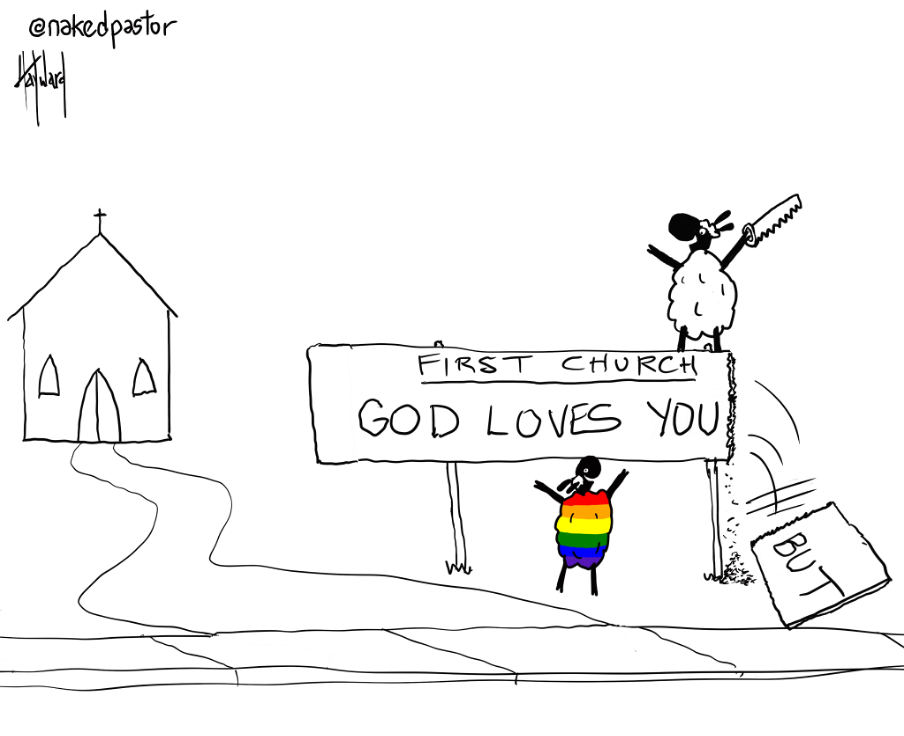
This illustration is from Naked Pastor, david@haywardart.com
Case Study 1
When Funding Follows Politics, Not People
A small organization working directly with transgender people in a low-income urban context had, for several years, received financial support from a coalition of local churches. The work was undeniably frontline: housing support, health navigation, trauma-informed counselling, and accompaniment through legal processes for those seeking identity documentation. The clients were among the most socially excluded people in the city — many had been rejected by their families, many had experienced violence, and a significant number had been trafficked or coerced into the sex industry precisely because they had nowhere else to turn.
Case Study 1 - The Funding Withdrawal
This case study is anonymized. Given the very small number of organizations working explicitly with transgender people in faith-affiliated networks, readers working in this context may recognize aspects of the situation described.
When the political climate shifted — and a vocal movement within several supporting congregations began framing transgender identity as incompatible with Christian values — the coalition began, one by one, to withdraw its financial support. No formal review of the organisation’s outcomes was conducted. No site visit was made. No conversation was held with the clients whose lives had been stabilized by the program. The decision was driven not by evidence of harm or ineffectiveness, but by a desire to avoid controversy within the congregation, and by alignment with a broader cultural-political position.
Within eighteen months, the organization had lost the majority of its church-based funding. Staff positions were cut. A waiting list that had already been long became indefinite. The transgender people the program had been serving did not disappear — they simply lost access to support that had been keeping them safe.
Where was the church’s mandate to “defend the weak and the fatherless; uphold the cause of the poor and the oppressed” (Psalm 82:3)? Nowhere visible in the funding decision. Political alignment had, quietly and without announcement, displaced scriptural mandate.
This is not an isolated pattern. Across multiple national contexts, FBOs working with LGBTQ+ populations report that church funding is among the most fragile — not because the work is poor, but because the constituency is politically uncomfortable. The tragedy is compounded by the fact that transgender people are among the most heavily targeted groups for trafficking and exploitation globally.1,2 Withdrawing support from organizations serving them is not a neutral theological position. It is a safeguarding failure.
Case Study 2
After the Raid: Girls Have Shelters, Boys Have Detention
An NGO conducting anti-trafficking work in a Southeast Asian city carried out a coordinated operation — with law enforcement — on a venue identified as a site of commercial sexual exploitation. Among those found were a group of girls and a smaller number of boys, all of whom showed signs of having been trafficked. All required immediate safe accommodation, psychosocial support, and access to legal processes.
Case Study 2 - Unequal Protection
Given the limited number of NGOs conducting operations of this kind in the region, and the very small number of organizations providing any residential care for boys, full anonymization is not possible. The pattern described is common across multiple countries and is documented in the peer-reviewed literature.
The girls were placed the same night in a faith-based shelter for young women — a well-resourced facility funded primarily by a consortium of international Christian donors. The shelter had beds, trauma counselors, legal advocates, and a reintegration program.
The boys had nowhere to go. No equivalent faith-based shelter existed for trafficked boys in the city. The government-run alternative was a juvenile detention facility — a place designed for young offenders, not victims. The boys, who had been commercially sexually exploited, were placed in an environment where they were exposed to peer violence, lacked access to trauma-informed care, and were at heightened risk of further exploitation and abuse. None received any faith-based pastoral support during their time in detention.
The church had mobilized extensively — and admirably — for the girls. The boys were invisible to its gaze. This absence of provision was not accidental. It reflects a well-documented pattern in which male victims of sexual exploitation — and particularly boys exploited in same-sex contexts — are rendered too complicated for the faith-based sector to engage.2,3,4 Boys exploited in same-sex contexts activate shame and “contamination anxiety” among faith-based staff in ways that female victim narratives rarely do — and it is this discomfort, not incapacity, that drives the avoidance.
Research across Cambodia, Thailand, and the Philippines has consistently documented the invisibility of male victims within both statutory and faith-based responses. Davis and Miles5,6 found that male survivors in the Butterfly Longitudinal Research Project experienced high rates of peer-to-peer violence during residential care and emotional violence from families after reintegration — outcomes worsened by placement in inappropriate facilities. Boys exploited in same-sex contexts face compounded stigma from service providers, communities, and churches, meaning they are less likely to be identified, less likely to be believed, and far less likely to receive appropriate care. Miles2 documented that some Christian FBO staff explicitly viewed exploited boys as “difficult and unmanageable” — revealing not incapacity but prejudice.
When the church builds shelters only for girls, it makes a theological and ethical statement, whether intentionally or not. It communicates: your suffering fits our categories; theirs does not.
Case Study 3
A Letter to the Editors: When Faith-Based Scholarship Causes Harm
A senior researcher with expertise in child protection and faith-based responses to vulnerability was invited to peer review an edited volume produced by a network of Christian scholars and practitioners. Most of the chapters were genuinely strong — grounded in evidence, careful in their use of scripture, and oriented toward the practical protection of vulnerable people. The researcher was prepared to recommend publication with minor revisions.
Case Study 3 - The Problematic Chapter
This case study is anonymized. The volume and chapter are not identified in order to protect the integrity of the peer review process and to focus attention on the broader issue rather than any individual publication.
One chapter was different. It drew on a theological framework focused on cataloguing what “God hates,” and within that catalogue placed same-sex sexual activity alongside bestiality. The language was not framed as a scholarly engagement with contested hermeneutics — it was presented as settled truth, in a chapter ostensibly addressing child protection. The researcher found no evidence-based content, no engagement with the safeguarding literature, and no acknowledgement of the harm that such language causes to LGBTQ+ people — including LGBTQ+ survivors of abuse and trafficking who might encounter the book.
The researcher wrote the following letter to the editors. The editors responded warmly. They wanted the volume to be dignifying. The chapter was lightly revised. The volume was published. The language remained.
To: The Editors
Re: Peer Review — Submitted Volume on Faith and Child Protection
From: Senior Researcher [name withheld; peer review confidentiality]
Dear Editors,
I am grateful for the opportunity to review this volume, which contains a number of chapters that are genuinely valuable contributions to the field. I write, however, with a significant concern that must be addressed before publication can be recommended.
Chapter [X] employs language that is, by any reasonable scholarly or safeguarding standard, homophobic. The equation of same-sex sexual activity with bestiality is not a neutral theological observation — it is a harmful comparison that has been used historically to dehumanize LGBTQ+ people and that has contributed directly to their marginalization, abuse, and in some contexts their persecution. In a volume addressing the protection of vulnerable people, such language is not only incongruous — it is dangerous.
I want to be clear: this is not a request that the editors resolve the long-standing theological debate about homosexuality. It is a request that the editors apply the same evidence-based, harm-aware framework that characterizes the volume’s strongest chapters to this one as well. What evidence does the author draw on? What is the empirical basis for the claims made? What consideration has been given to the impact of this language on LGBTQ+ readers — including LGBTQ+ survivors of trafficking and abuse, who are among the people this volume purports to serve?
The church’s calling to protect the vulnerable cannot be selectively applied to those whose vulnerability fits our cultural comfort. I would urge the editors to require a substantial revision of this chapter before publication proceeds, and to apply a clear harm-minimization standard to all content in the volume.
I remain willing to support the publication of a revised volume and commend the editors for the quality of the broader project.
Yours sincerely,
[Senior Researcher, name withheld]
This case study raises questions not only for editors and authors, but for the broader faith-based scholarly community. What responsibility do we bear when we lend our names to publications that cause harm — even when most of the content is good? At what point does the presence of harmful material in a volume undermine the credibility and safety of the whole? And how do we hold one another accountable — as scholars, as practitioners, and as people of faith — when our work falls short of the standards we profess?
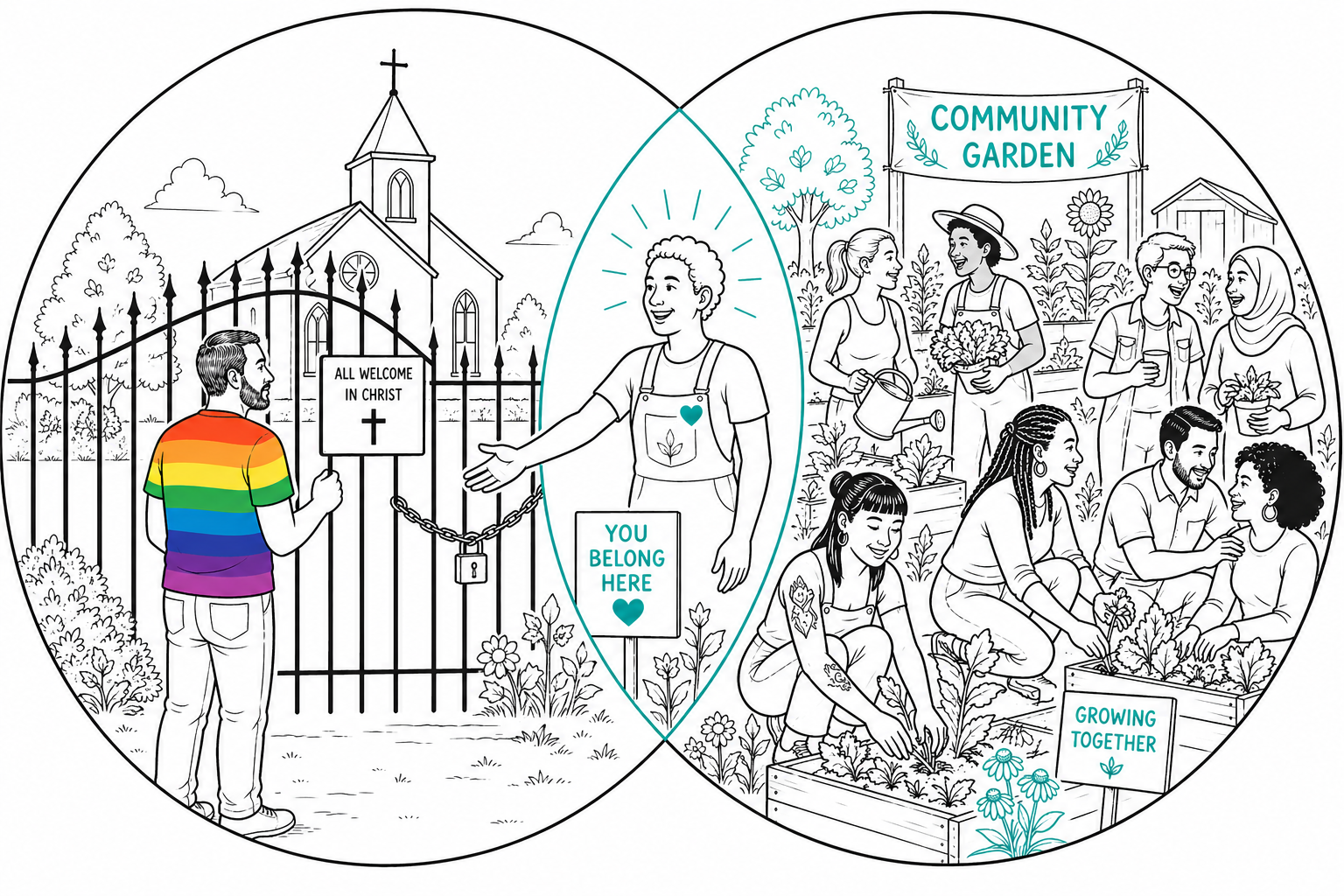
Conclusion: A Call to Integrity
These three case studies represent patterns, not exceptions: funding driven by politics rather than need; protection extended selectively by gender and perceived sexual identity; and scholarship that names and serves some vulnerable people while inadvertently — or deliberately — harming others. They are patterns that the faith-based sector has, on the whole, been slow to name and slower still to address.
This blog post is not an argument for any particular position on contested theological questions. It is an argument for integrity — for the alignment of what we say we believe with what we actually do. If the church’s mandate is to serve the poor, the marginalized, the exploited, and the excluded, then the sexuality or gender identity of the person in front of us cannot be the criterion by which we decide whether they deserve our care.
The person beaten on the road to Jericho did not have to earn the Samaritan’s help. The Samaritan did not check their theology before binding their wounds. The question the parable asks is not “Who deserves care?” but “Who will be a neighbor?” It is time for the church, and for faith-based organizations working in trafficking and safeguarding, to answer that question more honestly — and more practically — than we have so far.
“Which of these three do you think was a neighbor to the man who fell into the hands of robbers? The expert in the law replied, ‘The one who had mercy on him.’ Jesus told him, ‘Go and do likewise.’”
— Luke 10:36–37 (NIV)
Practitioners and policymakers reading this are invited to reflect:
Does your organization have referral pathways for LGBTQ+ victims of trafficking?
Are your shelters genuinely accessible to people of all genders and sexual identities?
Does your safeguarding training address the heightened vulnerability of LGBTQ+ people?
Does your publication and peer review process include a harm-minimization standard for content relating to marginalized groups?
When you encounter harmful content in a colleague's work, do you name it — and does your naming carry consequences?
These are not abstract questions. They are the difference between a church that serves the wounded person on the road and one that passes by on the other side.
References
Davis, J., & Miles, G. (2014). More than Gender: Looking at the vulnerabilities and resiliencies of transgender sex workers in Phnom Penh, Cambodia. Paper presented at the 6th Annual Interdisciplinary Conference on Human Trafficking, Lincoln, Nebraska. https://digitalcommons.unl.edu/humtrafcon6/4
Miles, G. M. (2016). Where are the boys? Where are the men? A case study from Cambodia. Transformation: An International Journal of Holistic Mission Studies, 33(3), 185–196. https://doi.org/10.1177/0265378816647599
Davis, J. D., & Miles, G. M. (2019). “They shamed me”: An exploratory study on the vulnerabilities of street-involved boys to sexual exploitation in Manila, Philippines. Dignity: A Journal of Analysis of Exploitation and Violence, 4(3), Article 2. https://doi.org/10.23860/dignity.2019.04.03.02
Davis, J. D., Glotfelty, E., & Miles, G. M. (2017). “No other choice”: A baseline study on the vulnerabilities of males in the sex trade in Chiang Mai, Thailand. Dignity: A Journal on Sexual Exploitation and Violence, 2(4), Article 10. https://doi.org/10.23860/dignity.2017.02.04.10
Miles, G. M., Havey, J., Miles, S., Piano, E., Vanntheary, L., Channtha, N., Phaly, S., & Sopheara, O. (2021). “I don’t want the next generation of children to be in pain like me”: The Chab Dai ten-year Butterfly Longitudinal Research Project on sex trafficking survivors in Cambodia. Dignity: A Journal of Analysis of Exploitation and Violence, 6(4), Article 2. https://doi.org/10.23860/dignity.2021.06.04.02
Davis, J. D., Havey, J., Miles, G. M., Channtha, N., Phally, S., & Vanntheary, L. (2021). “Going it alone”: Following the male cohort of survivors of sex trafficking of the Chab Dai Butterfly Longitudinal Research Project. Dignity: A Journal of Analysis of Exploitation and Violence, 6(4), Article 3. https://doi.org/10.23860/dignity.2021.06.04.03
Additional References
Dank, M., Khan, B., Downey, P. M., Kotonias, C., Mayer, D., Owens, C., Pacifici, L., & Yu, L. (2015). Estimating the size and structure of the underground commercial sex economy in eight major US cities. Urban Institute.
Davis, J. D., & Miles, G. M. (2020). “Strive harder and don’t lose hope”: Sexual exploitation of male youth in the sex trade in Manila. International Journal of Sociology and Social Policy, 41(5/6), 689–706. https://doi.org/10.1108/IJSSP-05-2020-0189
Greenbaum, V. J., Dodd, M., & McCracken, C. (2018). A short screening tool to identify victims of child sex trafficking in the health care setting. Pediatric Emergency Care, 34(1), 33–37. https://doi.org/10.1097/PEC.0000000000000761
Ottisova, L., Hemmings, S., Howard, L. M., Zimmerman, C., & Oram, S. (2016). Prevalence and risk of violence and the mental, physical and sexual health problems associated with human trafficking: Systematic review. Epidemiology and Psychiatric Sciences, 25(4), 317–341. https://doi.org/10.1017/S2045796016000135
About the Authors
Glenn Michael Miles, PhD is a Senior Research Scholar with GAHTS, an independent researcher, consultant, and research-practitioner with over 25 years of experience in child protection and anti-human trafficking, based in Swansea, Wales, UK. He is a Fellow of the Royal Society of Public Health and the Higher Education Academy, and holds advisory roles with Chab Dai Coalition, Alongsiders International, and Azalea/Flint Project. He has published extensively on the sexual exploitation of boys, young men, and transgender women in Southeast Asia. He identifies as a gay man and as a Christian, although he is aware that some people feel that he should choose one or the other.
Jarrett Davis, MA, is a researcher and practitioner with over fifteen years of experience in human trafficking, exploitation, and survivor-centered research design, with a particular focus on populations underserved by mainstream responses — including boys and young men, transgender and gender-diverse people, and street-connected youth. He has conducted field research across Southeast Asia and North America and has published on male and transgender vulnerability to sexual exploitation. He is a Senior Research Scholar with GAHTS. Where his work intersects with faith-based settings, he brings a critical and evidence-based lens to questions of institutional accountability and the protection of those most often overlooked.